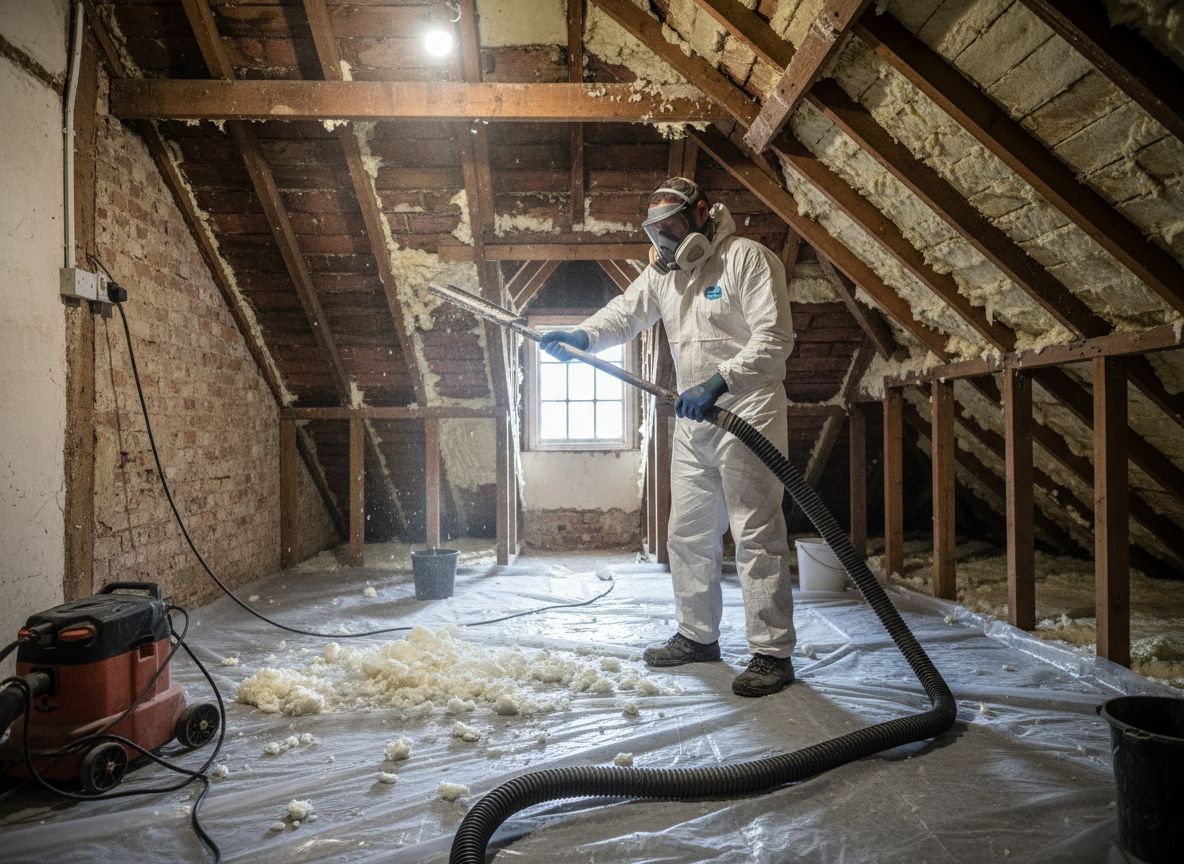
Loft spray foam removal in Yeovil often involves properties built before the 1970s around the town centre and nearby villages, where closed-cell foam was applied directly to slate and timber roofs. These older roofs frequently suffer from trapped moisture once the foam degrades, leading to rot in rafters that only becomes visible during removal. Work must account for Somerset's frequent rainfall, which makes the foam more brittle in winter and increases dust during cutting.
Technicians start by isolating the loft space to prevent insulation particles from entering living areas, then use manual scraping and low-speed tooling to separate foam from historic lath and plaster ceilings common in Yeovil terraces. Edge cases include foam that has expanded into wall cavities or around chimney stacks, requiring careful probing to avoid disturbing asbestos-containing materials found in some pre-1980s homes. Full removal also means clearing residual adhesive that can otherwise cause new insulation to fail.
Disposal follows Environment Agency rules for polyurethane waste, with all material bagged on site before transport from the Yeovil base at Ceres Natural Foods Ltd on Princes Street. Homeowners in surrounding areas such as Brympton and Preston Plucknett often need the service after previous foam installations failed to cope with the region's mild but persistently damp winters, which accelerate breakdown along roof valleys.
Technician insight
In Yeovil, the thing that catches most people out with loft spray foam removal is how tightly the foam bonds to the original rafters in 1930s-1950s houses around the town centre, especially after a wet winter when moisture has already started breaking down the timber behind the foam.
Condensation Issues in a Yeovil Terrace Loft
Homeowner noticed black mould along the ceiling joists in a pre-war terrace near Princes Street. Inspection found closed-cell foam trapping damp from the slate roof. Crew removed the foam by hand, treated the affected timber, and cleared all waste the same day, restoring ventilation to the loft.
How it works
- 1
Initial Loft Inspection
Assess foam type, depth, roof condition and any signs of moisture damage in Yeovil properties.
- 2
Containment Setup
Seal access points and protect floors to stop particles spreading through the house.
- 3
Foam Extraction
Remove foam using hand tools and mechanical methods suited to older timber and slate roofs.
- 4
Cleanup and Disposal
Vacuum residues, bag all waste and remove from site for compliant disposal.
Pricing
Cost depends on loft size, foam thickness and access difficulty; 24/7 availability from the Princes Street base allows flexible scheduling.