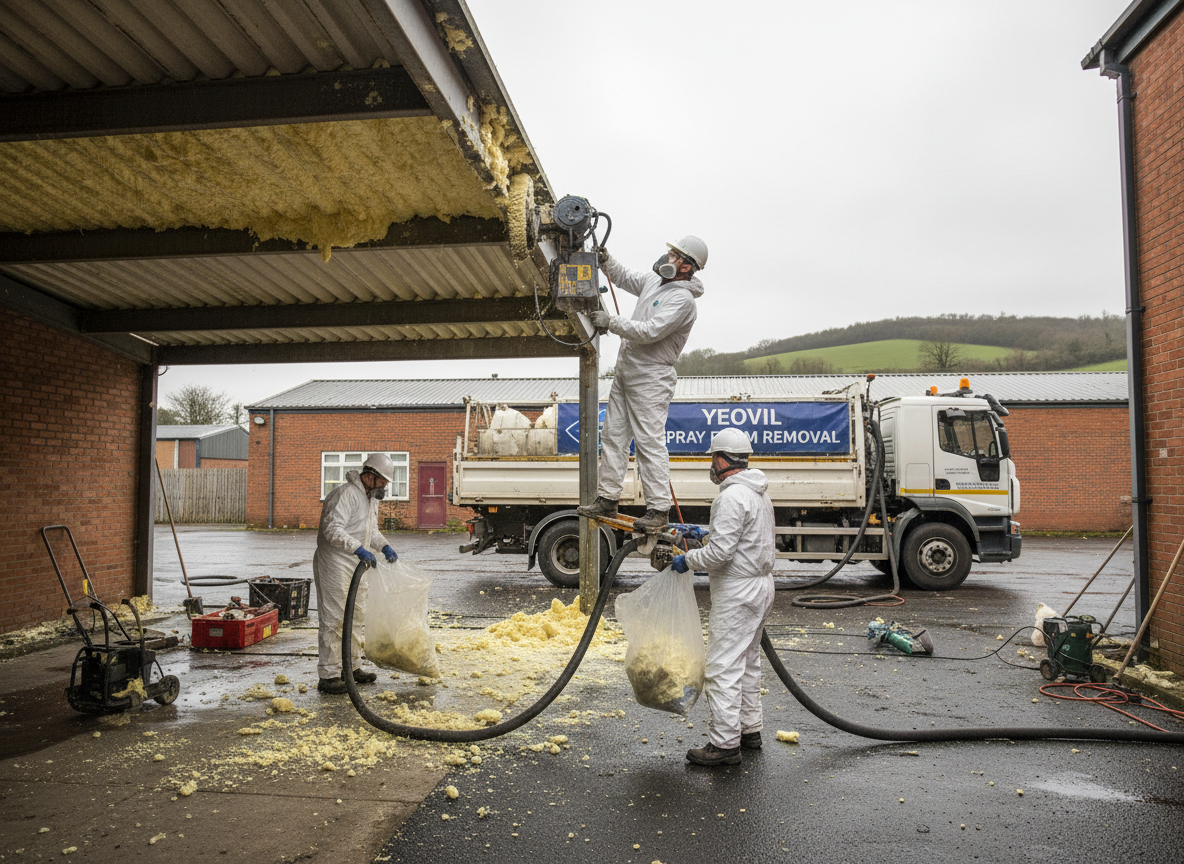
Commercial properties in Yeovil often feature post-war or Victorian-era construction with timber joists and limited ventilation, where spray foam was applied decades ago for insulation. Removing it requires isolating HVAC systems and containing dust to protect ongoing operations in units near the town centre or along Princes Street. Wet Somerset winters cause the foam to bond tightly to substrates and trap condensation, so crews must test for hidden damp before cutting begins to avoid spreading mould into adjacent retail or office spaces.
Edge cases include foam installed over electrical runs or pipework in converted warehouses around Yeovil, where improper removal risks damaging services that serve multiple tenants. UK building regulations require proper waste classification for polyurethane waste, so all material is bagged on site and taken to licensed disposal rather than left for general skips. In commercial settings the job frequently runs outside normal hours to limit footfall interruption, which is why 24/7 response from the Ceres Natural Foods Ltd address proves useful when a sudden odour complaint arises in a shop unit.
Practitioners watch for delamination where previous roof leaks have saturated the foam; this turns a straightforward peel into a layered removal that can expose original lath and plaster ceilings common in Somerset high-street buildings. Air quality monitoring continues throughout to keep neighbouring businesses unaffected, and final clearance includes negative-pressure verification before tenants return.
Technician insight
In Yeovil the thing that catches most people out with Commercial Spray Foam Removal is how the county's persistent rainfall drives moisture up through older commercial floors around the market and Princes Street, turning what looks like surface foam into a bonded layer that pulls plaster off when you try to lift it.
Retail Unit Near Yeovil Market
A shop unit reported musty smells after years of closed-cell foam in the ceiling. Inspection found water trapped between the foam and original lath from roof leaks common in the area. We isolated the space, removed the saturated sections in controlled strips, disposed of the waste and restored ventilation so trading could resume without further odour complaints.
How it works
- 1
Initial Site Survey
Walk the commercial space to map foam locations, note access constraints and check for moisture in Yeovil properties.
- 2
Containment Setup
Erect dust barriers and negative-pressure zones to protect adjacent retail or office areas during removal.
- 3
Mechanical Removal
Cut and peel foam in sections while monitoring for hidden services typical in older Somerset commercial stock.
- 4
Waste Handling and Clearance
Bag material for licensed disposal, vacuum residues and run air-quality checks before handover.
Pricing
Upfront quotes issued after on-site inspection because commercial layouts and foam depth vary widely across Yeovil units.