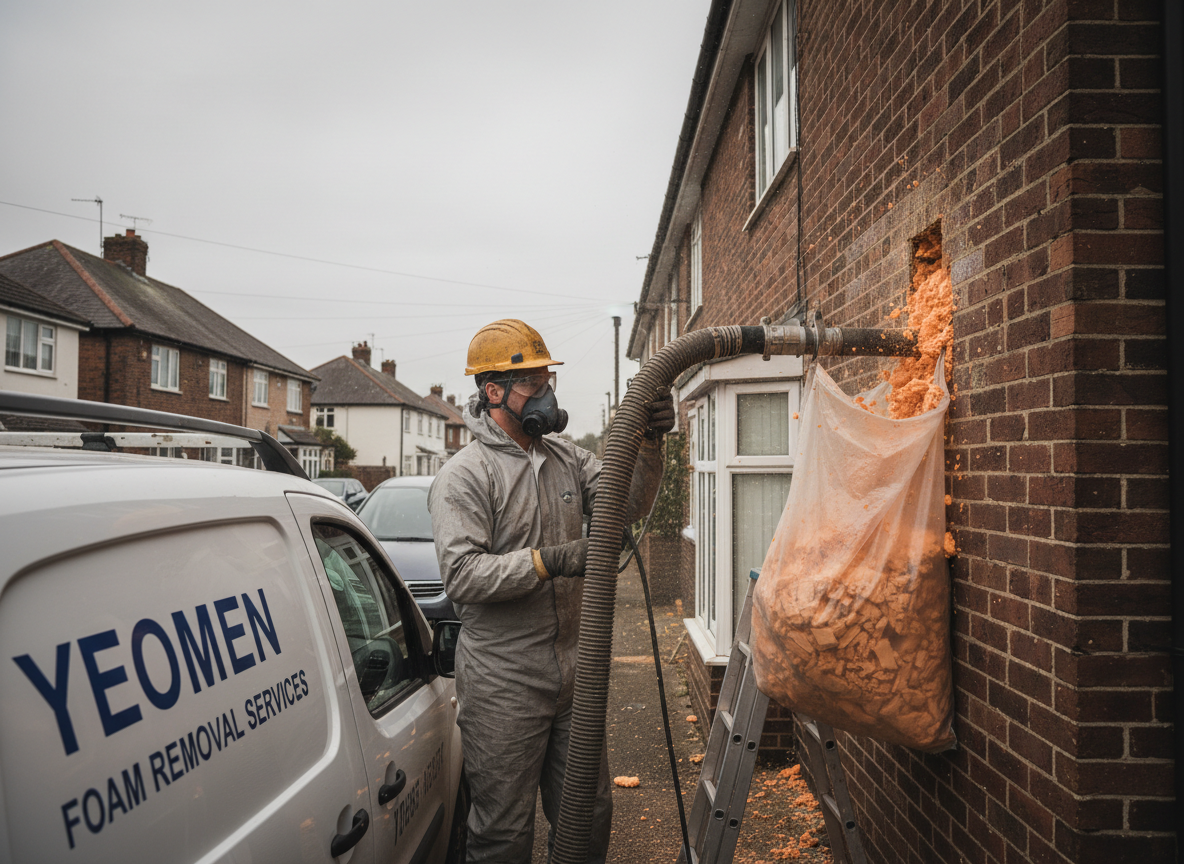
Cavity wall spray foam installed in Yeovil properties from the 1970s onward often creates hidden problems once it begins to degrade or trap moisture. Older terraced houses around the town centre and in areas such as Pen Mill and Hollands have narrow cavities and party walls that allow foam to migrate between dwellings. Removing it requires controlled cutting and vacuum extraction rather than simple scraping, otherwise residue stays lodged against brickwork and leads to recurring damp.
Access is frequently restricted in Yeovil’s Victorian and Edwardian stock where loft hatches are small and external walls sit close to boundaries. Technicians must work from inside the cavity using sectional tools to avoid disturbing electrical cables or insulation that was added later. Waste must be bagged on site and taken away the same day because Somerset County Council landfill rules treat cured polyurethane as non-household waste.
After foam removal, cavities are left ventilated and checked for residual bridging at wall ties. In properties near the River Yeo floodplain, any remaining foam can hold groundwater against the inner leaf, so a final borescope inspection is essential before re-plastering. Homeowners in Yeovil often discover the original install blocked the weep holes at the base of the wall, a detail that only becomes visible once the foam is gone.
Technician insight
In Yeovil, the thing that catches most people out with Cavity wall spray foam removal is the narrow cavities in 1930s terraces around the railway station where foam has crept across the party wall into the neighbour’s property, turning a single-house job into a shared-wall negotiation.
1930s Terrace Off Sherborne Road
Homeowner reported persistent damp on the gable wall after previous foam installation. Inspection showed foam had bridged the cavity and blocked weep holes. We extracted the foam through internal access points, cleared the base vents, and left the cavity ventilated. The wall dried out without further intervention.
How it works
- 1
Initial Cavity Survey
Borescope inspection through existing vents and drilled access points to map foam extent and locate party-wall migration.
- 2
Containment Setup
Dust sheets, negative-air units and floor protection installed to keep debris inside the property during extraction.
- 3
Foam Extraction
Sectional cutting tools and industrial vacuum removal of foam in layers, working from the top down to prevent collapse into lower cavities.
- 4
Final Clearance and Ventilation Check
All residue removed, weep holes cleared, and cavity left open for inspection before any re-plastering or insulation replacement.
Pricing
Cost depends on property age, cavity depth and access; we provide a clear quote after the on-site survey.